

 UpRising
 Cioara
Comments
A very interesting idea Cioara. Love the practicality and mobility of your design. Allowing library spaces to become more customised to meet individual's needs. What are two or three things you need assistance with?
Looking forward to seeing your idea develop.
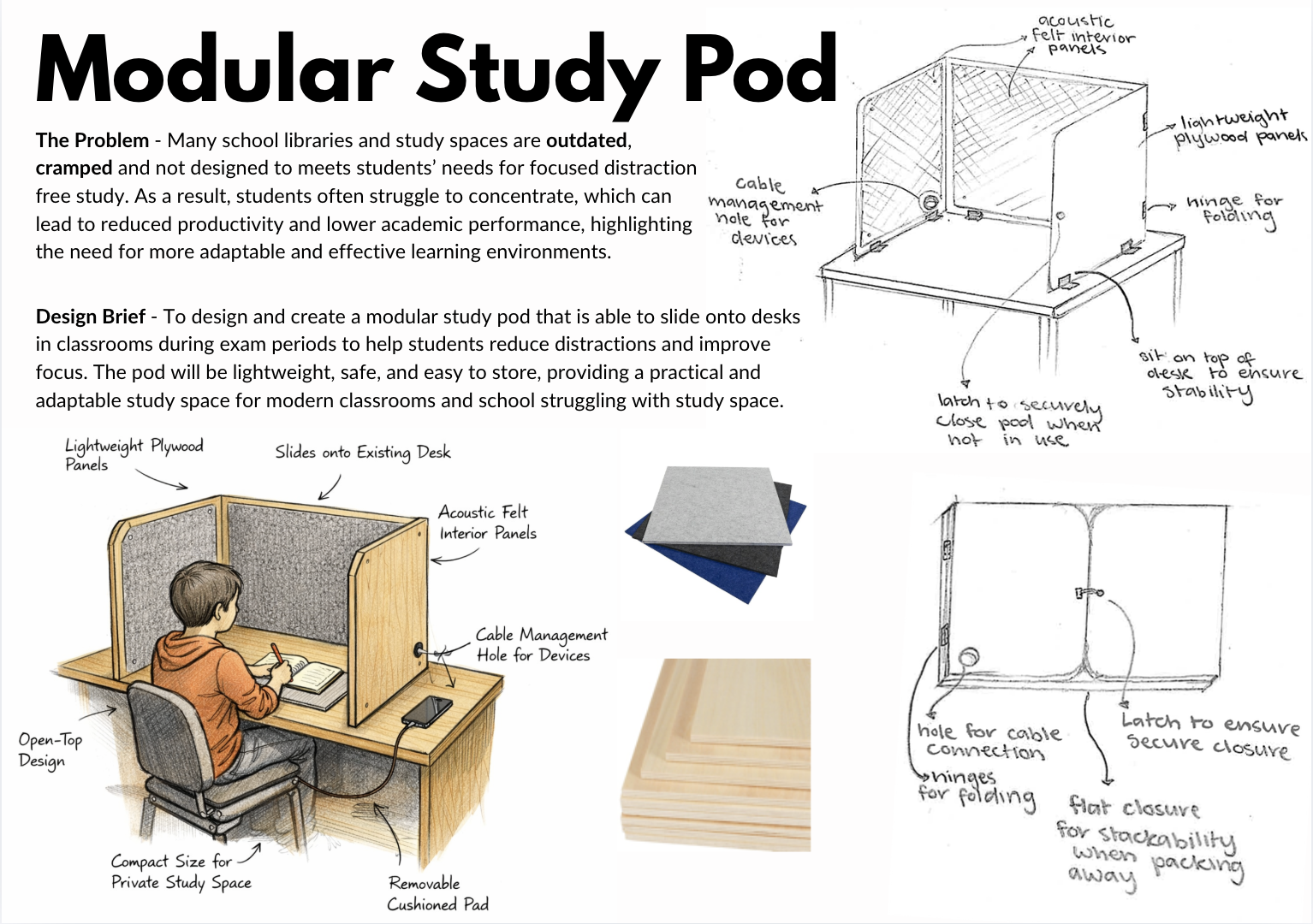
Open-plan layouts in contemporary interiors have increased the importance of carefully addressing issues around acoustics. This design demonstrates a thoughtful approach to both visual and acoustic privacy for focused work while also responding to the needs of a diverse range of neurodiverse students through the flexibility to add or remove the screen as required.
I have a question regarding how the screening element is securely fixed to the desk to ensure stability? Additionally, it would be useful to consider where the screen could be stored when folded. Could this be integrated into the overall design so that the storage solution forms a seamless part of the furniture system?
Good afternoon Cioara.
This company might be able to assist you with those questions,
https://thinkingw.com/collections/thinkingquietly/
Hi Cioara,
This is a very interesting idea that would allow schools and libraries to offer quieter spaces without having to purchase additional specialist desks etc. I like the idea of lightweight plywood panels for ease of construction on a small scale. On a larger scale I believe that a plastic outer casing filled with a cork or foam material may further reduce the weight of the product whilst improving on acoustic dampening.
I think adding a handle on the top of the study pod may also help with carrying the pod when it is folded down. Something similar to the plastic handles of a foldable picnic table would be useful.
I'm curious about the mechanism that connects the pod to the desk. From your drawing, it appears that there are some sort of hinge or right-angle bracket that helps the pod connect to the desk. Are these brackets fastened to the desk or do they just sit on top? Do they fold away with the pod when it is in it's closed position? An alternative maybe a small groove cut into the desk that helps the pod locate and remain stable?
Thanks,
Thomas Prescott,
CQ University ENEG12007
Hey Ciora,
Nice design and great idea. It will give schools & libraries the option of adding more lower sensory areas with the same amount of space. With society's growing acceptance and understanding of personalised & individual needs around sensory impact whilst studying and/or working. There is even an opportunity to expand into the growing market of co-working spaces, allowing people to set up their space in a way that suits their needs.
Currently, on your prototype drawing, I see 4 angular brackets for stability, perhaps some sort of bracing for the end of the panels facing the student and at the back of the panel, allowing it to sit a specified distance and potentially stop any lateral movement.
and finally, perhaps a carry case for transport, reducing any potential damage during transport and allowing for easy storage.
Looking forward to updates
cheers
Matt (CQU ENEG12007)

 Aje_Castillo
 jaydes
 japanisturning...
 Cwell
Cwell